
The Tree of the Hesperides was located in Iberia (modern Spain and Portugal), according to Greek mythology.It was protected by Ladon, a dragon and the Hesperides nymphs (daughters of Atlas or Nyx).It produced golden apples. Myths and Legends. Atalanta picks up the apples as Hippomenes takes the lead. The Tree was given to Hera as a wedding gift from Gaia. The Garden of the Hesperides is located just in front of where Atlas holds the burden of the sky. The Garden of the Hesperides is Hera's orchard in the west, where either a single apple tree or a grove grows, producing golden applesthat grant immortality when eaten.
Hesperides, (Greek: “Daughters of Evening”) singular Hesperis, in Greek mythology, clear-voiced maidens who guarded the tree bearing golden apples that Gaea gave to Hera at her marriage to Zeus. According to Hesiod, they were the daughters of Erebus and Night; in other accounts, their parents were Atlas and Hesperis or Phorcys and Ceto. The Hesperides was a steamer of British registry, home port of Liverpool, England, Official Number of 87978. She was built in Liverpool by R&J Evans & Company in 1884. Constructed on Iron, the ship was 2404 GRT and had 2 decks. Product description A rich, long lasting citrus perfume Sparkling, sweet, fresh & sensual Top notes of Italian lemon, orange, grapefruit Middle notes of bergamot, lotus.
These three Nymphs, daughters of Nyx and Erebus, look after the very rare apple tree Golden Immortalitus, not to be confused with Golden Delicious. This shines with the golden radiance of a glorious sunset, which is why the Hesperides are also Sunset Goddesses.
The Golden Apples were given to Hera as a wedding present by Gaia. Trouble-maker Eris stole one, and to preserve the rest Hera planted them in a beautiful garden. A Golden Apple tree grew there, and along flounced some nymphs to nibble at the fruit.
Wagging a warning finger, Hera put a dragon called Ladon on guard duty. The nymphs took one look at his hundred slavering heads and turned over a new golden leaf. From that moment they devoted themselves to tending the tree. Hera tended not to trust them but Ladon was there to prevent any scrumping.
Aegle does the shining, Hespera does the watering (she was also known as Arethusa but took on an alternative name to avoid confusion with the well-known nymph), and Erytheia pores over the best times for pruning and picking. Hestia pops in from time to time to tend the flowerbeds.
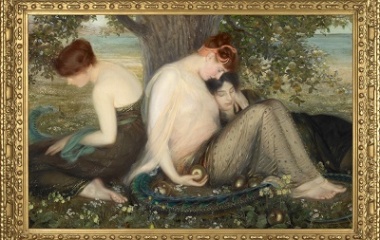
The Hesperides are best of friends with Atlas, who is a close neighbor. Some legends even claim he is their father by Hesperis. Other legends give Zeus the credit, and one or two cynical folk claim the Hesperides are simply a flock of golden sheep.
Episode 11: The Apples Of The Hesperides
Heracles had originally been sentenced to Ten Labors. Returning in triumph with the Cattle of Geryon, he was hoping to take a well-deserved vacation. But the mean-minded Eurystheus claimed two of the Labors were null and void.
“That Hydra business — your nephew did half the work, and there seems to be a head missing. As for the stable-cleaning scam for profit — for which a court case is still pending — no way! Still two Labors to go, laddie.”
Steam came out of Heracles’s ears but he stayed in control and headed off to find the Golden Apples. No-one could tell him where they were, and he floundered around until he came across the sleeping Sea God Nereus. Knowing of his wisdom, he seized him by the beard and twisted both advice and information out of him...
The plan involved using Atlas, who was best friends with the Golden Apple nymphs. To avoid unnecessary delays, Heracles climbed up the orchard wall and shot Ladon the dragon with a Hydra dart, leaving the coast clear for nymph negotiations.
Atlas was holding up the Celestial Globe of the Heavens at the time. So Herc offered to take over his burden whilst the deed was performed. Atlas could not believe his luck. It was such a weight off his shoulders. What a relief!
Atlas certainly took his time hobnobbing with the Hesperides. To the sweating Heracles, he seemed to be gone for years. Finally he sauntered back with three Golden Apples and a big grin. Atlas was in no hurry to resume his supporting role.
“I’ll tell you what, dude,” he said, “hang on in there and I’ll take the apples back to Eurywhotsit for you. It’s no trouble. I’ll be back in a month or two.”
After Ten Labors, Heracles had learnt to match wits with the best. And Atlas was far from smart. “Sure thing, bud. Thanks very much. Oh, before you go, I’m getting a bit of a headache. Can you take over for a sec while I put a bit of padding on my head..?”
Was Atlas that gullible? Yes he was, and found himself holding up the Heavens once more. So Heracles returned to Mycenae with the Golden Apples, which Eurystheus then donated to Athena... who then returned them to the Hesperides where they’d come from in the first place. Heracles may have been heard to use bad language at this point.
Final Episode: The Capture Of Cerberus...
Name: Hesperides
Pronunciation: Coming soon
Alternative names: Hesperids
Gender: Female
Type: Spirits
Celebration or Feast Day: Unknown at present
In charge of: the Evening
Area of expertise: Evening, Sunset
Good/Evil Rating: NEUTRAL, may not care
Popularity index: 2446
Hesperides Relationships
Father: ErebusHesperides Garden
Mother: NyxMember of:Nymphs
Members:Aegle, Erytheia, Hespera
Hesperides Greek Mythology

Who is the father of Hesperides?
Who is the mother of Hesperides?
Link to this page
HTML: To link to this page, just copy and paste the link below into your blog, web page or email.
BBCODE: To link to this page in a forum post or comment box, just copy and paste the link code below:
Cite this article
Here's the info you need to cite this page. Just copy the text in the box below.

Article last revised on September 06, 2018 by Rowan Allen.
Editors: Peter J. Allen, Chas Saunders
References: Coming soon.
We are often asked about mythology merchandise. Do we sell Hesperides graphic novels, books, video or role-playing games (RPG)? To purchase such goodies we suggest you try Amazon, Ebay or other reputable online stores. For official Godchecker merch please visit our God Shop where a wide range of items are available to buy.
The Apples of the Hesperides
Poor Hercules! After eight years and one month, after performing ten superhuman labors, he was still not off the hook. Eurystheus demanded two more labors from the hero, since he did not count the hydra or the Augean stables as properly done.
Eurystheus commanded Hercules to bring him golden apples which belonged to Zeus, king of the gods. Hera had given these apples to Zeus as a wedding gift, so surely this task was impossible. Hera, who didn't want to see Hercules succeed, would never permit him to steal one of her prize possessions, would she?
Hesperides Gardens Wa
These apples were kept in a garden at the northern edge of the world, and they were guarded not only by a hundred-headed dragon, named Ladon, but also by the Hesperides, nymphs who were daughters of Atlas, the titan who held the sky and the earth upon his shoulders.
The Hesperides in the garden. Here the apples are on a tree, and the dragon Ladon looks more like a single-headed serpent.
London E 224, Attic red figure hydria, ca. 410-400 B.C.
Photograph courtesy of the Trustees of the British Museum, London
Hercules' first problem was that he didn't know where the garden was. He journeyed through Libya, Egypt, Arabia, and Asia, having adventures along the way. He was stopped by Kyknos, the son of the war god, Ares, who demanded that Hercules fight him. After the fight was broken up by a thunderbolt, Hercules continued on to Illyria, where he seized the sea-god Nereus, who knew the garden's secret location. Nereus transformed himself into all kinds of shapes,trying to escape, but Hercules held tight and didn't release Nereus until he got the information he needed.
Hercules fighting Kyknos
Toledo 1961.25, Attic red figure kylix, ca. 520-510 B.C.
Photograph by Maria Daniels, courtesy of the Toledo Museum of Art
Continuing on his quest, Hercules was stopped by Antaeus, the son of the sea god, Poseidon, who also challenged Hercules to fight. Hercules defeated him in a wrestling match, lifting him off the ground and crushing him, because when Antaeus touched the earth he became stronger. After that, Hercules met up with Busiris, another of Poseidon's sons, was captured, and was led to an altar to be a human sacrifice. But Hercules escaped, killing Busiris, and journeyed on.
Hercules wrestling Antaeus
Tampa 86.29, Attic black figure neck amphora, ca. 490-480 B.C.
Photograph by Maria Daniels, courtesy of the Tampa Museum of Art
Hercules came to the rock on Mount Caucasus where Prometheus was chained. Prometheus, a trickster who made fun of the gods and stole the secret of fire from them, was sentenced by Zeus to a horrible fate. He was bound to the mountain, and every day a monstrous eagle came and ate his liver, pecking away at Prometheus' tortured body. After the eagle flew off, Prometheus' liver grew back, and the next day he had to endure the eagle's painful visit all over again. This went on for 30 years, until Hercules showed up and killed the eagle.
Eagle with wings outstretched.
Philadelphia MS553, Corinthian alabastron, ca. 620-590 B.C.
Photograph by Maria Daniels, courtesy of the University of Pennyslvania Museum
In gratitude, Prometheus told Hercules the secret to getting the apples. He would have to send Atlas after them, instead of going himself. Atlas hated holding up the sky and the earth so much that he would agree to the task of fetching the apples, in order to pass his burden over to Hercules. Everything happened as Prometheus had predicted, and Atlas went to get the apples while Hercules was stuck in Atlas's place, with the weight of the world literally on his shoulders.
Woman juggling apples.
Toledo 1963.29, Attic red figure, white ground pyxis, ca. 470-460 B.C.
Photograph by Maria Daniels, courtesy of the Toledo Museum of Art
When Atlas returned with the golden apples, he told Hercules he would take them to Eurystheus himself, and asked Hercules to stay there and hold the heavy load for the rest of time. Hercules slyly agreed, but asked Atlas whether he could take it back again, just for a moment, while the hero put some soft padding on his shoulders to help him bear the weight of the sky and the earth. Atlas put the apples on the ground, and lifted the burden onto his own shoulders. And so Hercules picked up the apples and quickly ran off, carrying them back, uneventfully, to Eurystheus.
There was one final problem: because they belonged to the gods, the apples could not remain with Eurystheus. After all the trouble Hercules went through to get them, he had to return them to Athena, who took them back to the garden at the northern edge of the world.
Hercules in the garden of the Hesperides.
Sometimes the hero is portrayed in the garden, even though the story we have from Apollodorus is that he sent Atlas there instead of going himself.
London E 224, Attic red figure hydria, ca. 410-400 B.C.
Photograph courtesy of the Trustees of the British Museum, London
(md)
To read more about these topics, see Further Resources.
- Labor 11: The Apples of the Hesperides
Hesperides St
This exhibit is a subset of materials from the Perseus Project database and is copyrighted. Please send us your comments.