


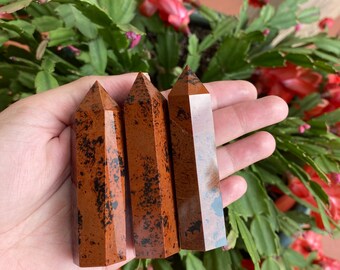

Black, brown, red, and snowflake obsidian can be found here on BLM lands. Roughly 2/3 of Utah ‘s lands are controlled by the BLM, so there are many opportunities for rockhounds to add to their collection of obsidian. Nearby Piute County is another area in Utah with numerous obsidian sources. A detailed map will be needed to determine which of. Outstanding nice swirls red ribbon black obsidian. THIS IS GEM QUALITY OBSIDIAN FROM GLASS BUTTE, IN CENTRAL OREGON. THIS OBSIDIAN CAN BE KNAPPED INTO BEAUTIFUL SPEAR, ARROW, KNIFE, OR SPEAR POINTS AND CAN ALSO BE CABBED INTO BEAUTIFUL CABS I mpurities in obsidian change its appearance; for example, iron may cause it to appear reddish brown. Obsidian has a glassy lustre and is slightly harder than window glass. Though obsidian is typically jet-black in colour, the presence of hematite (iron oxide) produces red and brown varieties, and the inclusion of tiny gas bubbles may create a golden sheen. Other types with dark bands or mottling in gray, green, or yellow are also known.
Red Obsidian Healing Properties
Obsidianis volcanic glass. It often has flow lines that create interestingeffects. Gold sheen and silver sheen obsidian's display gold andsilver shimmerings when polished, rainbow obsidian displays differentcolors, etc. Obsidian has a reputation for being difficult to polish.Usually the reason for difficult polishing is that coarse grits cancreate a fairly deep fracture zone that doesn't come out when thestone is cut at finer grits. Another problem is obsidian doesn'tpolish well if it gets too hot. So, if you don't use super coarsegrinding wheels and if you keep your polishing wheel slow and wet,good results will easily be obtained. Diamond wheel finishing workswell.
Usually Obsidian is a jetblack stone with a vitreous (glassy) lustre. Just like glass, obsidiantends to shatter into sharp fragments when hit hard, this strength andbrittleness have resulted in its use as sharp cutting implements andweapons such as spear and arrowheads or inserted into wood madewonderful clubs. Pure obsidian is usually dark in appearance, thoughthe color varies depending on the presence of impurities. Iron andmagnesium typically give the obsidian a dark brown to black color. Veryfew samples are nearly colorless. In some stones, the inclusion ofsmall, white, radially clustered crystals of quartzlike cristobalite inthe black glass produce a blotchy or snowflake pattern (snowflakeobsidian). It may contain patterns of gas bubbles remaining from thelava flow, aligned along layers created as the molten rock was flowingbefore being cooled. These bubbles can produce interesting effects suchas a golden sheen (sheen obsidian) or an iridescent, rainbow-like sheen(rainbow obsidian).